About
Our research group explores the intersection of nonlinear optics, quantum optics, integrated optics and ultrafast spectroscopy leveraging the unique properties of low-dimensional materials, e.g., van der Waals layered compounds like graphene and transition metal dichalcogenides (TMDs).
With their strong light-matter interaction and exceptional nonlinearities, these atomically thin materials can be nano-engineered into highly efficient and ultracompact platforms (e.g., periodically-poled crystals, metasurfaces, etc, up to 1000x thinner than conventional nonlinear crystals) for a wide range of nonlinear processes, including optical parametric amplification, or entangled photon pair generation via spontaneous parametric down-conversion (SPDC). Particularly promising for photonic quantum computing, in which quantum operations are performed by manipulating the quantum states of photons, low-dimensional materials serve as nanoscale sources of photonic qubits.
From unveiling new quantum phenomena to developing compact, efficient platforms for next-generation photonic quantum technologies, we develop innovative solutions to push the boundaries of what’s possible at the nanoscale.
Funding
Our research is supported by:
European Union—NextGenerationEU under the National Quantum Science and Technology Institute (NQSTI) Grant No. PE00000023-q-ANTHEM-CUP H43C22000870001; Tech Europe Foundation (TEF); European Union’s Horizon Europe research and innovation programme under the Marie Skłodowska-Curie PIONEER HORIZON-MSCA-2021-PF-GF grant agreement No 101066108; Optica Foundation through the 2024 Optica Foundation Challenge (q-POLIS) and the 2022 Bernard J. Couillaud Prize.



Publication highlights
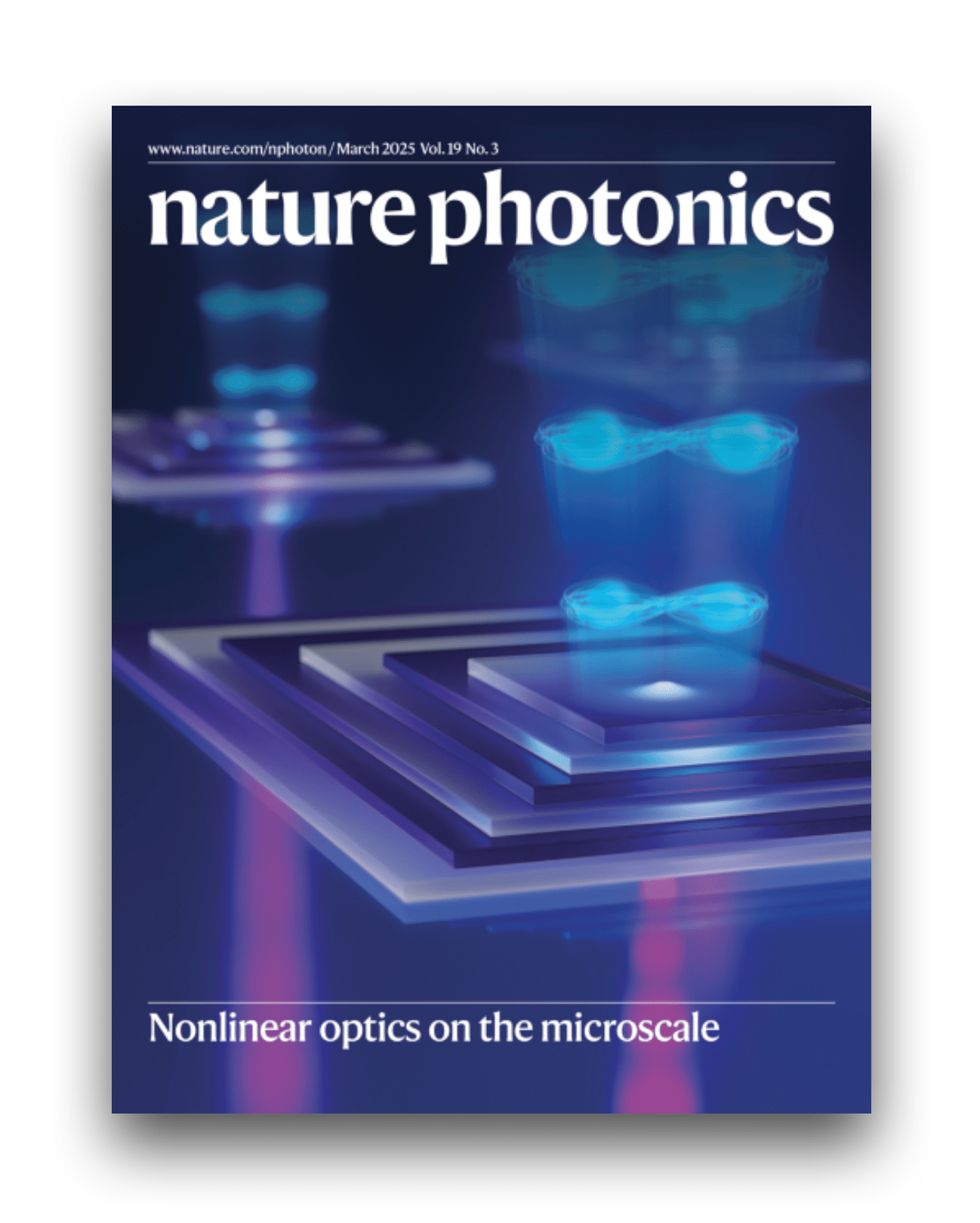
C. Trovatello et al. “Quasi-phase-matched up- and down-conversion in periodically poled layered semiconductors”, Nature Photonics, 19, 291–299 (2025)
Z. H. Peng*, M. Cotrufo*, […], A. Alù, P. J. Schuck, C. Trovatello “3R-stacked transition metal dichalcogenide non-local metasurface for efficient second-harmonic generation”, Nature Photonics, 19, 1376–1384 (2025)
Articles




Reviews & Perspectives
See more on:

 Chiara Trovatello